
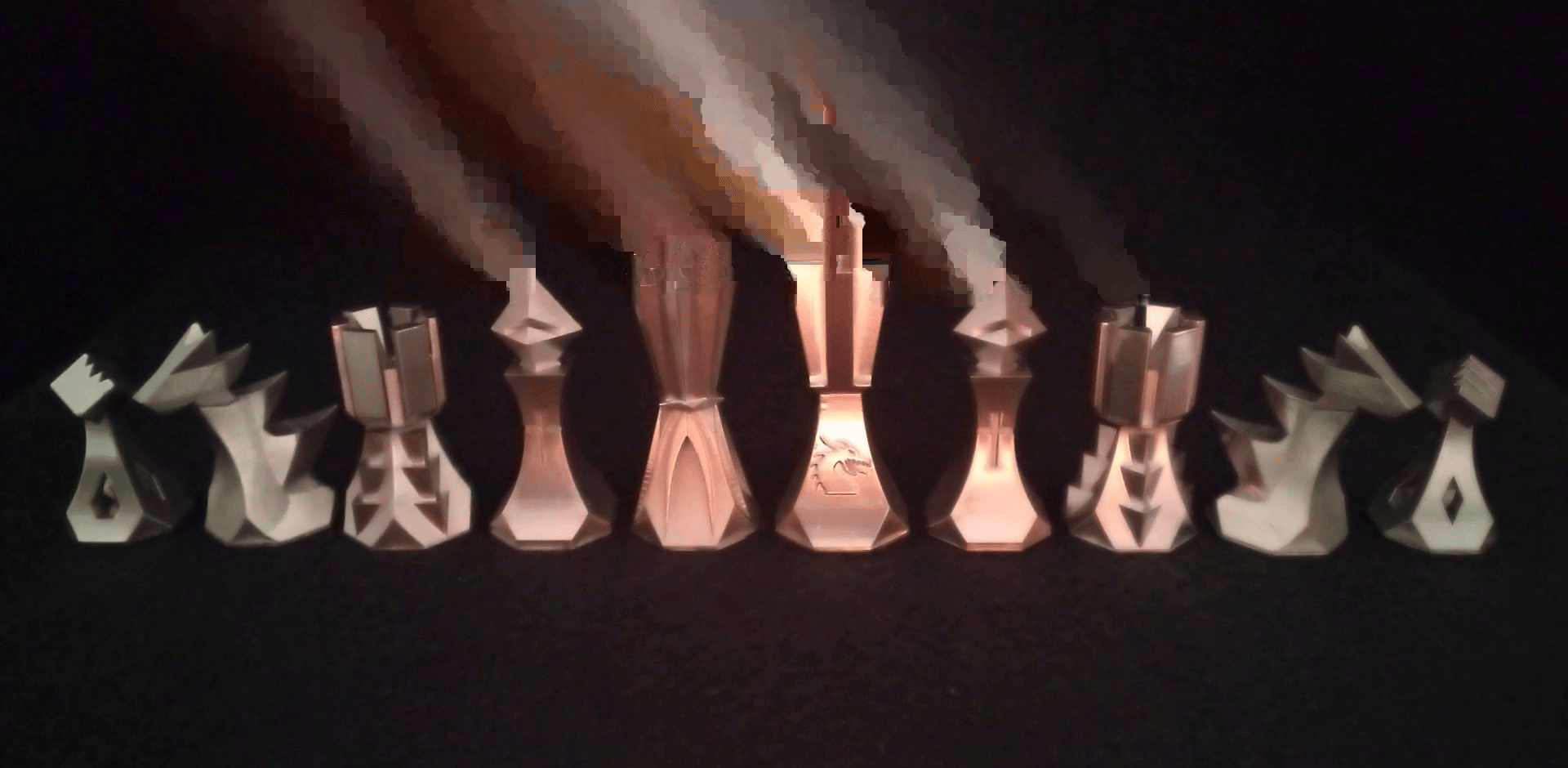
Q: What happens when one king suddenly appears directly beside the other king on a player’s back row?
A: Easy. Whichever player has the next move wins. What? You’ve never seen a king capture a king? Welcome to Adrenaline chess.
.
Q: Can a pawn that reaches his opponent’s back row promote to ANY same color piece?
A: On the physical game board, yes. In the digital version a pawn will always promote to a queen.
.
Q: What if I manage to occupy EVERY octagon on my opponent’s back row?
A: Great question! We’ve never seen it happen. We assume the game would stop dead without a winner – although you might safely call it a “psychological” win.
.
Q: When my opponent’s king suddenly appears on his back row, can I capture it with a “pinned” piece to win the game?
A: Absolutely. The moment a king is captured the game is over, so it won’t matter that you are in check.
.
Q: Is Adrenaline a fair game?
A: Not by the same measure as classical chess. But is White moving first “fair”? How about a coin toss? AC is fair in the sense that both players receive the same pieces, if they survive long enough. AC is also fair in the sense that it is unpredictable for both players. “Luck,” being fickle, rarely plays favorites for long (which is why we recommend winning 2 out of 3). In short, AC is uncertain for both players – which makes the game more real and visceral than classical chess.
And remember, winning against the odds is a serious thrill !
.
.
.
Highlights in the History of Chess
6th century AD – Presumed advent of the game we know as chess (in India).
1495 – Birth of modern chess: To mirror Queen Isabel (and other powerful female figures like Eleanor of Aquitaine) the chess queen is made the most powerful piece on the board. (Isabel is known for her role in the Spanish Inquisition and for sending Columbus west).
15th-17th centuries – Europe responds to the more powerful queens by allowing kings to leap over a piece on their first move. Eventually this morphs into modern castling, which solidifies by the 17th century.
To shorten games and pick up the pace, pawns may advance 2 squares on their first move.
1849 – Howard Staunton (considered the best player in the world at the time) enthusiastically endorses 6 simple, elegant chess piece designs that continue to be the most widely used and recognized throughout the world today.
1851 – In what became known as the “Immortal Game,” Adolf Anderssen sacrifices a bishop, both rooks and his queen to Lionel Kieseritzky before checkmating him. Kieseritzky is stunned, having lost only 3 pawns (and the game).
1886 – First official world chess championship match. 10 victories takes the title. Initial 5 games are played in New York City, the next 4 in St. Louis, and the final 11 in New Orleans. Austrian Wilhelm Steinitz wins 10-5 along with 5 draws.
1924 – Birth of the World Chess Federation (FIDE)
1972 – American Bobby Fischer handily wins the World Chess Title against the monolithic Russian juggernaut in the person of Boris Spassky. It is the first (and only) time an American has achieved that distinction. This match is still widely considered the greatest event in chess history.
1997 – The rise of computers: Deep Blue defeats World Champion Garry Kasparov, signaling the end of human domination of classical chess.
2019 – First Fischerandom chess tournament. In an unprecedented move, FIDE recognizes a new variety of chess, stating, “Fischer Random is a positive innovation: It injects new energies and enthusiasm into our game. It has won the favor of the chess community, including the top players and the world champion himself. FIDE couldn’t be oblivious to that: It was time to embrace and incorporate this modality of chess.”
2020 – Invention of Adrenaline chess (short-board random introduction chess) to restore “spontaneous talent and creativity” to the game.
The old chess is too limited. Imagine playing cards, black jack for example, and every time the dealer has the same starting hand you have the same starting hand. What’s the point? ~ Bobby Fischer